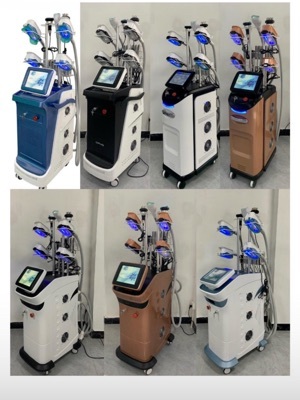
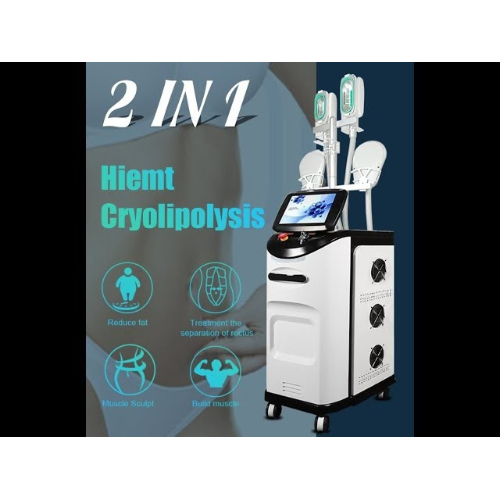
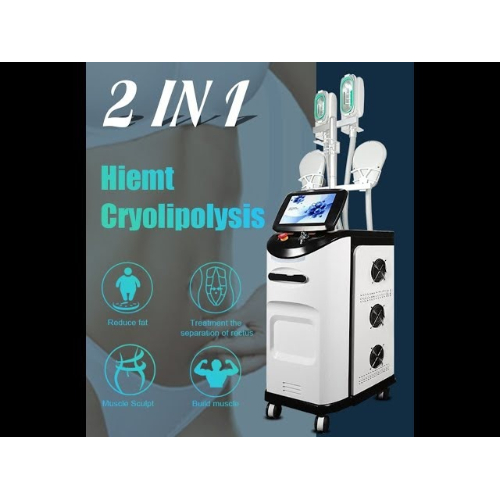
The image appears to show a 2-in-1 cryolipolysis/body-contouring machine, with applicators intended for fat-freezing and additional body-contouring functions. However, the photograph does not establish the exact manufacturer, applicator model, temperature range, vacuum pressure, or treatment protocol.
Cryolipolysis (fat freezing) uses controlled cooling to target pinchable subcutaneous fat. It is a body-contouring procedure, not a weight-loss treatment.
1. Main parts of your machine
From the photograph, I can see:
- Touchscreen treatment-mode and parameter controls
- Emergency-stop button immediately stops the system
- Two upper applicator holders likely for the cryolipolysis applicators
- Large cooling/vacuum system the side fans indicate substantial heat exchange
- Wheels portable floor-standing unit
- Possibly a second modality marketed as muscle sculpt/build muscle this needs confirmation from the machine's actual specifications
The wording HIEMT Cryolipolysis in your picture suggests the manufacturer is marketing two technologies in one system. Don't assume the HIEMT function is actually present or clinically equivalent to a dedicated electromagnetic muscle-stimulation device without the model documentation.
2. How cryolipolysis works
The applicator draws a fold of pinchable fat into the cup using vacuum and cools the tissue.
The basic sequence is:
Vacuum tissue pulled into applicator controlled cooling treatment completed applicator removed
The FDA describes cryolipolysis as controlled cooling intended to damage fat cells while avoiding freezing injury to the skin.
It is important that the applicator is used only on appropriate tissue and approved anatomical areas for that particular device.
3. Typical touchscreen controls
Your exact menu may contain some or all of these:
| Control |
Function |
| Mode |
Selects treatment function |
| Applicator |
Selects connected handpiece |
| Temperature |
Controls/monitors cooling |
| Vacuum |
Controls suction |
| Time |
Treatment duration |
| Start/Pause |
Starts or pauses treatment |
| Stop |
Ends treatment |
| Cooling |
Controls cooling system |
| Pressure/Vacuum display |
Shows suction level |
| Temperature display |
Shows applicator/tissue-related temperature |
Do not enter a temperature, vacuum level or treatment time from a generic online protocol. Your machine may use different sensors, applicators and safety limits.
4. Basic operating procedure
Before treatment
- Check the machine and cables.
- Inspect the applicator for cracks or damage.
- Confirm the cooling system is functioning.
- Verify that the applicator is the correct one for the intended body area.
- Examine the skin and underlying tissue.
- Ensure there is enough pinchable fat for the applicator.
- Use the manufacturer's specified protective membrane/gel pad if required.
- Position the client comfortably.
- Record the treatment area and baseline photographs/measurements.
- Keep the emergency stop accessible.
Treatment
- Select the appropriate cryolipolysis mode.
- Select the correct applicator.
- Place the required protective membrane between the applicator and skin.
- Position the applicator according to the manufacturer's anatomical guide.
- Start vacuum at the manufacturer's prescribed setting.
- Confirm that the tissue is being drawn appropriately into the applicator.
- Start cooling/treatment.
- Monitor the patient continuously.
- Monitor temperature/vacuum alarms.
- Stop immediately if there is unexpected severe pain or a safety alarm.
- At completion, stop vacuum before removing the applicator according to the machine's instructions.
5. Do NOT treat these areas casually
Cryolipolysis should not simply be placed anywhere there is fat.
The FDA specifically warns about treatment near hernias and structurally weak areas, including surgical scars and abdominal muscle separation.
Avoid treating over:
- Known or suspected hernia
- Abdominal-wall weakness
- Open wounds
- Active skin infection
- Significant skin disease/inflammation
- Areas with inadequate tissue for the applicator
- Areas not approved for that particular applicator/device
A qualified clinician should also screen for cold-related disorders.
For example, the established safety information for FDA-cleared CoolSculpting specifically lists cryoglobulinemia, cold agglutinin disease and paroxysmal cold hemoglobinuria as conditions in which treatment should not be performed.
6. Important side effects
Normal/temporary reactions can include:
- Redness
- Swelling
- Bruising
- Tenderness
- Numbness
- Temporary discomfort
The FDA also warns about freeze burns, nerve effects in certain locations, and persistent numbness.
The unusual complication you must know: PAH
Paradoxical adipose hyperplasia (PAH) is a rare but important complication unique to fat-freezing procedures.
Instead of becoming smaller, the treated fatty tissue becomes a firm, enlarged bulge, often corresponding to the shape of the applicator. It can develop 25 months after treatment and may require surgery.
This is one reason I would not recommend learning cryolipolysis simply by copying settings from another machine.
7. About the HIEMT part
Your advertisement says:
2 IN 1 HIEMT Cryolipolysis
and shows claims such as:
- Reduce fat
- Muscle sculpt
- Build muscle
This appears to be a combination body-contouring platform, but the photograph alone doesn't tell us what technology the HIEMT portion actually uses.
If you send me a picture of the HIEMT applicator(s) and the machine's touchscreen switched on, I can explain that section separately.
8. I can give you a complete operating guide for this exact machine
Please send me these 3 photos:
1. Touchscreen while the machine is ON
2. Close-up of the cryolipolysis applicator(s), including the label on them
3. The model/specification sticker on the back or side
Then I can explain the machine screen button by button, including:
Power Cryolipolysis mode applicator selection temperature vacuum treatment time START monitoring STOP applicator removal cleaning shutdown.
I can also explain the HIEMT side separately once I can see its applicators and menu.
 Send Inquiry


 Send Inquiry

 Send Inquiry